
Weapons and Weapon Power
There are 24 weapons in the release build and seven in the demo, but the split that actually decides runs is simpler than the weapon list: weapons that apply stacks and weapons that just do damage. Stacking weapons get better every time you take Weapon Power. Flat damage weapons do not, which is why a demo build that leans on Pinball and Bubbles outscales one that leans on raw hits.
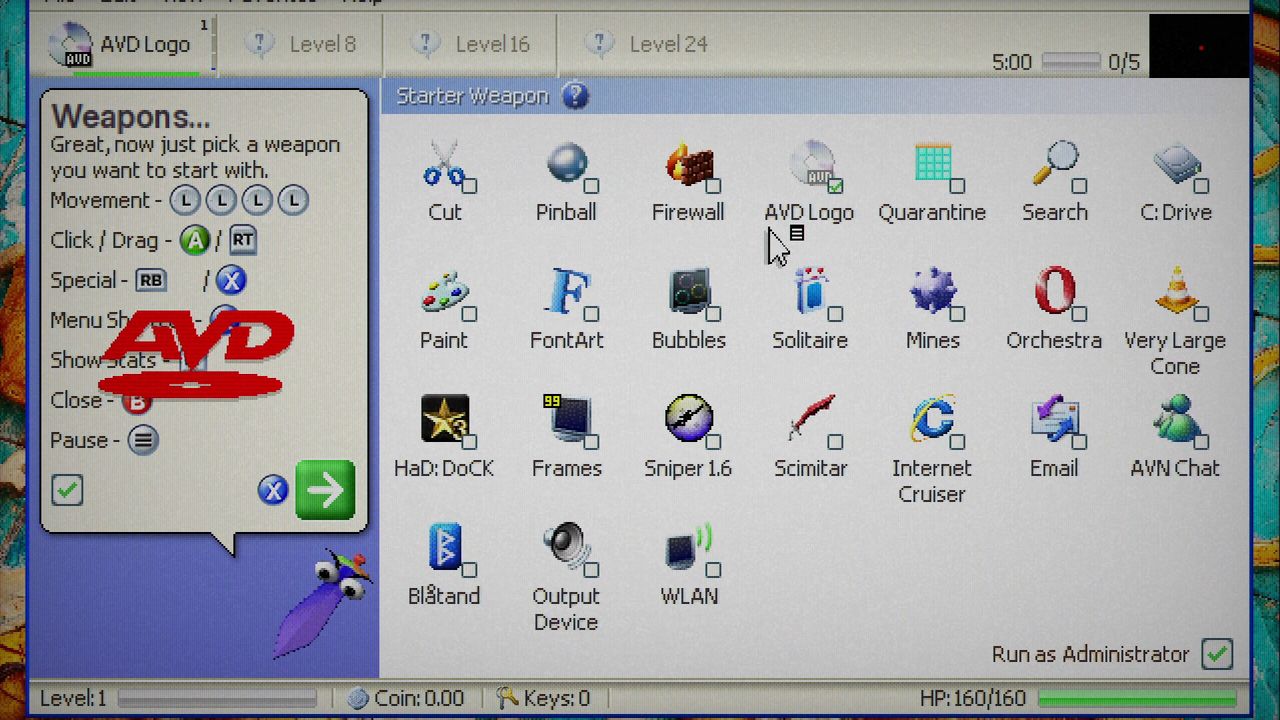
What the game confirms so far
| Weapon | Where it comes from | What it does |
|---|---|---|
| Pinball | Store page, demo, patch notes | Hardest knockback of any weapon in the build |
| Firewall | Store page, demo, Demo 1.2 notes | Now applies Heat |
| Mines | Store page, demo | Listed alongside Pinball and Solitaire as a core early weapon |
| Solitaire | Store page | Named as part of the launch roster |
| C: Drive | Demo page | Named as part of the demo roster |
| Bubbles | Demo 1.2 notes | Floating screensaver bubbles, damage over time, stacks Infect |
| Paint | Demo 1.2 notes | Draws and fills circles, damage over time, stacks Lag |
| AVD | Demo 1.2 notes | Weakest knockback in the demo roster per the notes |
That is eight of the twenty-four named in official material. The rest of the launch roster has not been itemised by the developer yet, so any site listing all 24 names with damage numbers is working from datamined data or from guesswork. Steam screenshots show more icons on the weapons panel than the notes name, including what reads as Scimitar, Sniper, WLAN, Internet and Email.
Weapon Power, and why it replaced Repel
Demo 1.2 did the most important balance change in the game's short history: the Repel stat became Weapon Power, and its job changed.
- Power raises how many stacks of Heat, Lag and Infect a weapon applies.
- Power also makes knockback hit harder — Repel's old job, but now attached to the same stat.
- Knockback from the default values is no longer useless. The notes are blunt about this: a weapon's base knockback now pushes enemies back properly, and Power turns a shove into a wall.
The practical consequence is that a single stat now drives both your damage ceiling and your crowd control. That is the most efficient stat in the game on a stacking build, and it is close to dead weight on a build that never applies a status.
Knockback strength is weapon-specific rather than uniform. Pinball hits hardest, AVD hits least — the developer called both out by name when explaining the change, which is as close to a knockback tier list as the game has published.
The four weapon archetypes in the launch build
The release notes describe the expanded roster in four flavours, which is a better guide to building than any single weapon's damage number:
- Direct fire — weapons that shoot at enemies rather than emitting an effect around you.
- Passives — weapons that work without you aiming or positioning them.
- High-HP targeting — weapons that pick the biggest thing on screen.
- Status appliers — weapons that exist to stack Heat, Lag or Infect.
A run that only ever buys from one of these columns is a run with a hole in it. Status appliers without direct damage cannot clear a screen fast enough to open folders; direct damage without stacks hits a ceiling against anything armoured or late.
How to pick, in practice
- One primary damage weapon, upgraded hard. Drivers (the launch build's 50 weapon upgrades) reward depth on a single weapon more than spreading upgrades around. The demo already shows the per-weapon pattern: a Legendary offer called C: Drive Repel raises that one weapon's knockback by 70% and does nothing for anything else in your slots.
- One or two status appliers matched to what your primaries do. Bubbles for Infect, Paint for Lag, Firewall for Heat.
- Pinball when you need space. The one weapon that has a developer-confirmed knockback crown is worth a slot purely as a panic button.
- Check the level-up card text before the icon. Rarity colours tell you how special an offer is; the description tells you whether it feeds the stat you have been buying.
The demo's 37 plugins can push any of this sideways, and the interaction between plugins and status apps is where builds stop looking alike — see plugins, keygens and keys.